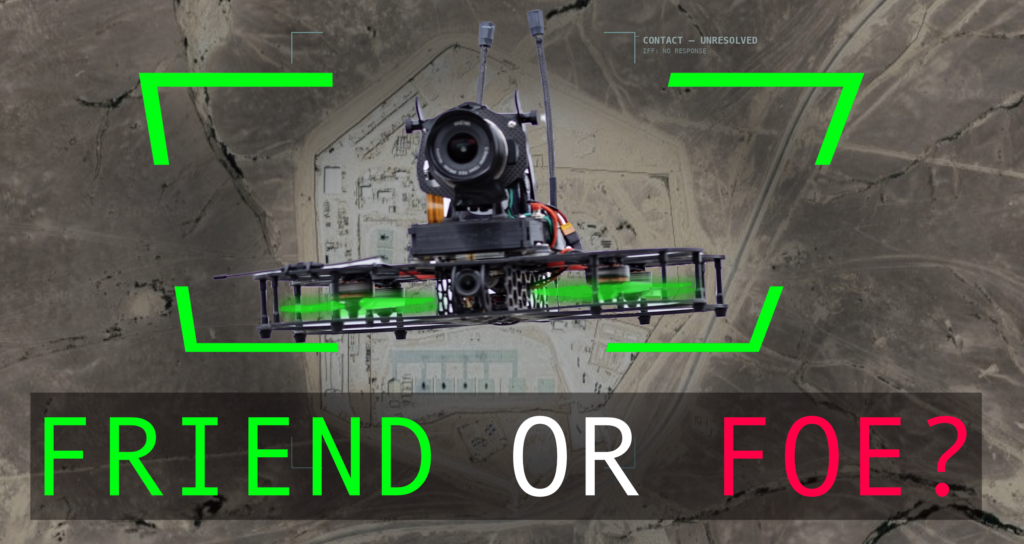
Friend or Foe: Why Drone Identification Is Failing

The Tower 22 Failure

Drone Identification - Friend or FoeOn 28 January 2024, a drone struck Tower 22, a US military outpost in northeastern Jordan, killing three American soldiers and wounding more than forty others. The base was equipped with radar, counter-drone systems, and trained personnel — none of which prevented the attack, because the failure was not one of detection. Soldiers monitoring the base defense operations center had observed radar tracks approaching from the south but had not investigated them, in part because a US surveillance drone operated by Task Force 99 — a CENTCOM unit that deliberately operated cheap commercial and 3D-printed platforms precisely because their low cost made them expendable — was returning to base at almost exactly the same moment, and there was no reliable means of distinguishing one from the other.1

This was a failure of identification, and it is precisely the kind of failure that is becoming more frequent as unmanned systems saturate every domain of modern conflict. The radar saw the drone. What it could not do was tell anyone whether that drone belonged to them.

The architecture at the root of this problem is one the defense world has relied on since the Second World War. Identification Friend or Foe systems built around radio frequency interrogation were designed for a different era — one in which platforms were expensive, relatively few in number, and purpose-built to carry the electronics required to participate in an RF exchange. That era is over, and the gap between what RF-based IFF was designed for and what it is now being asked to do is widening with every conflict.2
 

Not an Isolated Incident

Tower 22 was not an isolated failure of training or equipment. It was a structural problem — one that has since appeared across multiple theaters and domains, each time in a different form.

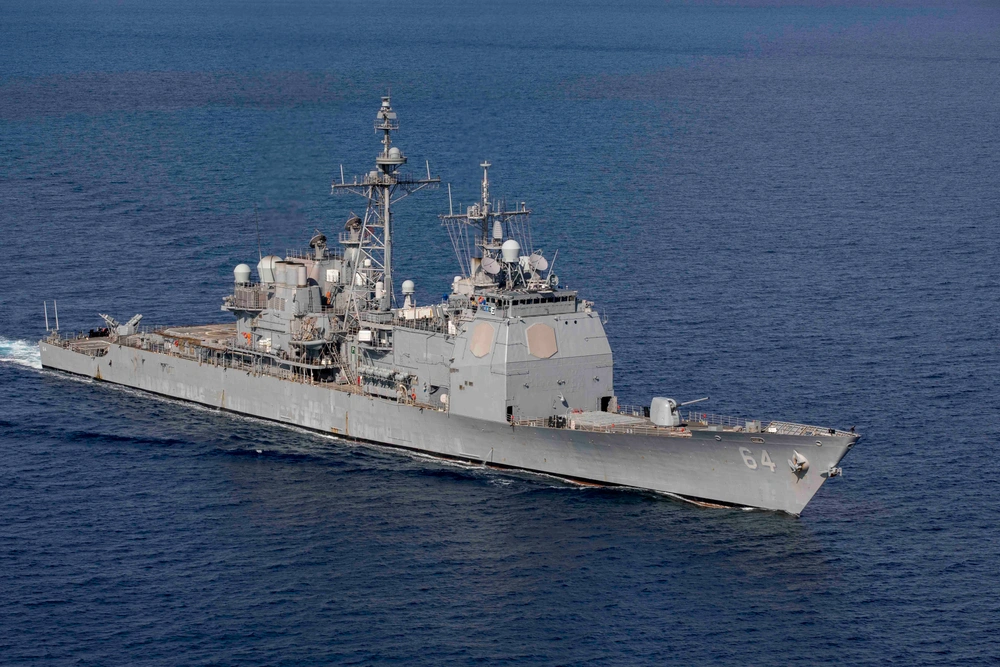
U.S. 5TH FLEET AREA OF RESPONSIBILITY 12.16.2024 Photo by Petty Officer 2nd Class Kaitlin Young USS GETTYSBURG

In December 2024, the guided missile cruiser USS Gettysburg shot down a US Navy F/A-18F Super Hornet returning to its carrier during an active engagement against Houthi forces in the Red Sea. The IFF system aboard the Gettysburg had been experiencing intermittent failures throughout the deployment, none of which had been escalated to the crew relying on it. When the decision to engage was made, the watch-standers on duty did not know their primary identification system was degraded. The aircraft was classified as hostile and destroyed.3


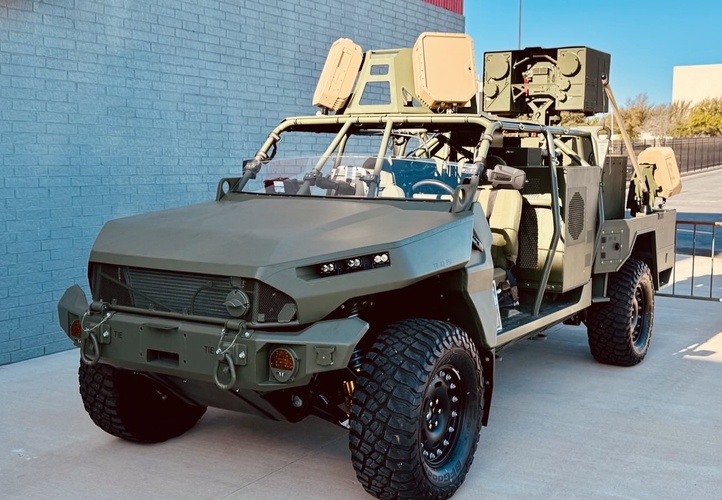
A US military directed-energy laser destroyed a US Customs and Border Protection surveillance drone near Fort Hancock, Texas, at an estimated cost of thirty million dollars. CBP had not notified the Pentagon it was operating in the area. The military system detected the drone, assessed it as a threat, and engaged it — because no identification layer existed that could have told it otherwise.4

A US Army M1301 Infantry Squad Vehicle equipped with a BlueHalo LOCUST Laser Weapon System at Fort Sill’s annual Fires Symposium in April 2025. (US Army photo)

Three incidents, three different operational contexts, three different failure modes — and the same root cause in each. Not a radar that failed to detect. An identification architecture that was not built for the environment it is now operating in.5

Why RF-Based IFF Is Breaking Down

That environment is defined by two realities RF-based IFF was never designed to handle simultaneously. The first is volume — Ukraine is targeting production of over seven million drones in 2026, while Russia was launching over a thousand Shahed-type platforms per week at peak, deliberately mixing armed drones with unarmed decoys to force engagement decisions on contacts that could not be reliably classified.6 The second is economics. As Dr. Thomas Withington, one of the foremost analysts of electronic warfare, has observed: “Equipping such a UAV with an IFF system severely undermines the supposed disposability which is a key asset of these aircraft.7 Fitting a five hundred dollar drone with a thousand dollar transponder is not a procurement decision — it is a contradiction.

Toward Passive Drone Identification

The answer to both problems — volume and economics — cannot itself be electronic. A solution that adds weight, power dependency, and cost to a platform defined by its absence of those things will not be adopted at the scale the problem requires. What is needed is an identification layer that adds nothing to the platform except the marking itself.

Ultraviolet fluorescent pigments offer exactly that. Applied as a coating, an ink, an adhesive element, or embedded directly during resin printing, they respond to optical excitation with a characteristic emission that is immediate, binary, and requires nothing from the platform carrying it — no power, no electronics, no firmware, no additional weight. An interrogating system directs a pulsed UV light source toward a drone in its field of view — in any lighting condition. A marked platform fluoresces in visible light. An unmarked one does not. The identification result is unambiguous, and it is produced without any radio frequency exchange that can be detected, jammed, or spoofed.8


The system also supports color-differentiated marking. A reconnaissance drone marked in one color and an artillery spotting drone marked in another give any soldier who encounters either an immediate, unambiguous read on what it is and how to respond — without any radio exchange, and without any prior coordination beyond knowing the color protocol. The same principle scales across different units, coalition partners, or government organizations sharing the same airspace.9

Near-infrared pigments extend the same principle into the NIR spectrum — unidentifiable without an infrared camera or night vision equipment, and readable at greater distance by sensor systems already standard in modern military operations.10

Built on Proven Technology

These are not experimental materials. Luminochem has spent over two decades developing high-security optical pigments for document authentication — the same technology used in high-security printing applications worldwide. That anti-spoofing architecture is directly transferable to drone identification.11

The application of these pigments to drone identification is the subject of ongoing research and testing. Results are specific to the pigments being tested — manufacturing standards in this field vary significantly, and findings from one supplier are not transferable to another. Pigment samples are available now for client-side testing and integration evaluation.

Luminochem is the world’s largest dedicated manufacturer of UV fluorescent high-security pigments, with a two-decade track record supplying security-critical optical materials to government institutions across more than fifty countries. Tailored formulations can be discussed directly with our technical team.


If the identification gap described in this article is relevant to your work, we invite you to reach out. A detailed technical study is available under NDA — covering operational case studies and application protocols across military, law enforcement, and civilian domains. NDA signatories receive updates as new findings from ongoing testing are validated. Contact us to request access or to discuss sample availability.


Luminochem manufactures and sells pigment. UV fluorescent pigments are commercial chemical materials, not defence articles, and are not subject to defence export controls under EU or US regulatory frameworks. No defence industry licence is required to procure them.

Do you want to learn more?


This field is for validation purposes and should be left unchanged.
Your Name(Required)


Please leave a message indicating product name with possible quantity, intended application and printing technology.

References

[1] Tower 22 — Drone IFF Failure, Jordan (January 2024) — Internal case study note, lines 1–15. External source: Washington Post, 6 April 2025: https://www.washingtonpost.com/national-security/2025/04/06/jordan-tower-22/

[2] Luminochem Drone IFF Whitepaper — Section 2.1, paragraph 1, lines 1–4. Internal document — contact Luminochem to request access under NDA.

[3] USS Gettysburg — IFF System Failure, Red Sea (December 2024) — Internal case study note, lines 1–12. Internal document — contact Luminochem to request access under NDA. External source: The War Zone: https://www.twz.com/air/how-uss-gettysburg-shot-down-a-super-hornet-and-nearly-another

[4] US Military Shoots Down CBP Drone — Border IFF Failure, Texas (February 2026) — Internal case study note, lines 1–8. Internal document — contact Luminochem to request access under NDA. External source: Task & Purpose: https://taskandpurpose.com/news/military-laser-cbp-drone-texas/

[5] Luminochem Drone IFF Whitepaper — Section 2.1, paragraph 3. Internal document — contact Luminochem to request access under NDA.

[6] The Age of Drone Warfare — Nagorno-Karabakh and Russo-Ukrainian War — Internal case study note, Part Two, Ukraine production figures. Internal document — contact Luminochem to request access under NDA. External source: CSIS — Drone Saturation: Russia’s Shahed Campaign: https://www.csis.org/analysis/drone-saturation-russias-shahed-campaign

[7] Withington, T. “Identity Crisis.” European Security and Defence, November 2025: https://euro-sd.com/2025/11/articles/technology/47765/identity-crisis/

[8] Luminochem Drone IFF Whitepaper — Section 3.1, paragraphs 1–2. Internal document — contact Luminochem to request access under NDA.

[9] Luminochem Drone IFF Whitepaper — Section 5.3, paragraph 4. Internal document — contact Luminochem to request access under NDA. External: Luminochem_Technical_Summary— Section 3, UV-A Fluorescent Pigments.

[10] Luminochem Drone IFF Whitepaper — Section 3.4, paragraphs 1–2. Internal document — contact Luminochem to request access under NDA.

[11] Luminochem Drone IFF Whitepaper — Section 4.2, paragraph 2. Internal document — contact Luminochem to request access under NDA.

[12] Luminochem Drone IFF Whitepaper — Section 6.1, paragraphs 1–2. Internal document — contact Luminochem to request access under NDA.

[13] EU Dual-Use Regulation 2021/821; US Export Administration Regulations (EAR) — EAR99 classification framework.

WANT TO READ MORE FROM US?

Sign up to our mailing list to receive relevant and exclusive industry news, fun facts, emerging trends, and updates on our newest developments.

close